Latest 2026 Price List for 3-Door Elevators
Introduction to 3-door floor elevators
Three-door floor elevators are an advanced elevator solution specifically designed to meet the transportation needs of buildings with complex architecture or multiple access points. Unlike traditional elevators with only one or two doors, this type of elevator has three doors opening at different locations on the same floor, facilitating movement and optimizing the flow of passengers or goods.
Technically, three-door elevators are typically designed with a special rail system and door opening mechanism to ensure safety and efficient operation. The door opening mechanism can be automatic or semi-automatic, depending on the usage requirements and design of each building. The arrangement of three doors on the same floor minimizes waiting time and more effectively manages passenger flow, preventing congestion at entrances and exits.
Technical specifications and construction
- Door structure: Three doors are positioned in different locations on each floor, which could be the front, side, or back door depending on the building design.
- Rail and cabin system: The elevator cabin is specially designed to accommodate door opening in multiple directions, ensuring smooth and safe operation.
- Control system: Utilizes an intelligent controller capable of identifying and directing passengers, optimizing travel routes, and minimizing downtime at each floor.
- Safety features include: door sensors, anti-jamming system, safety brake, and a fully integrated emergency alert system.
- Materials used in construction: Typically, stainless steel, tempered glass, and fire-resistant materials are used to ensure durability and safety during use.
The outstanding advantages of a 3-door floor elevator.
- Increased accessibility: With three doors, the elevator can serve multiple access points, making it ideal for buildings with numerous walkways or corridors.
- Reduced waiting times: Streamlining passenger flow through multiple gates minimizes congestion and shortens elevator waiting times.
- Space saving: Instead of installing multiple elevators for each direction, a 3-door floor elevator optimizes the use of space within the building.
- Increased transportation efficiency: Suitable for both passenger and cargo transport with high traffic volume, especially in commercial buildings and high-end apartment complexes.
- Meeting complex architectural requirements: Elevators can be customized to fit diverse and intricate floor plans.
Practical applications
Three-door floor elevators are commonly used in the following types of buildings:
- Office buildings: Buildings with multiple entrances or corridors, where there is a high volume of people coming and going and a need for flexible movement.
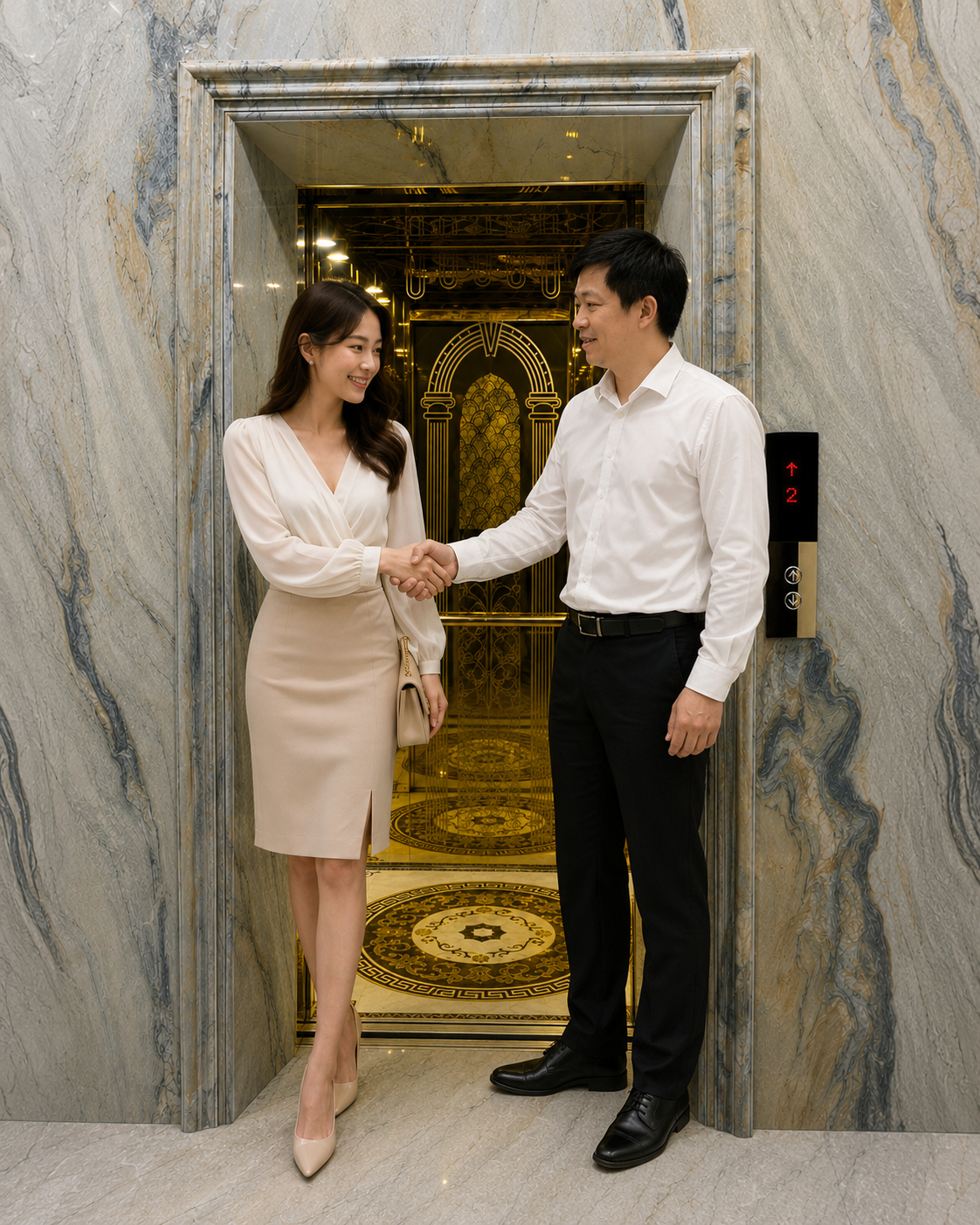
- Luxury apartments: Allow residents easy access to different areas within the building without having to navigate long corridors.
- Hotels: Meeting the need for quick transportation of guests and luggage, while also providing convenience for guests staying at the hotel.
- Shopping malls and supermarkets: Serving a large volume of customers and goods, helping to increase business efficiency and user experience.
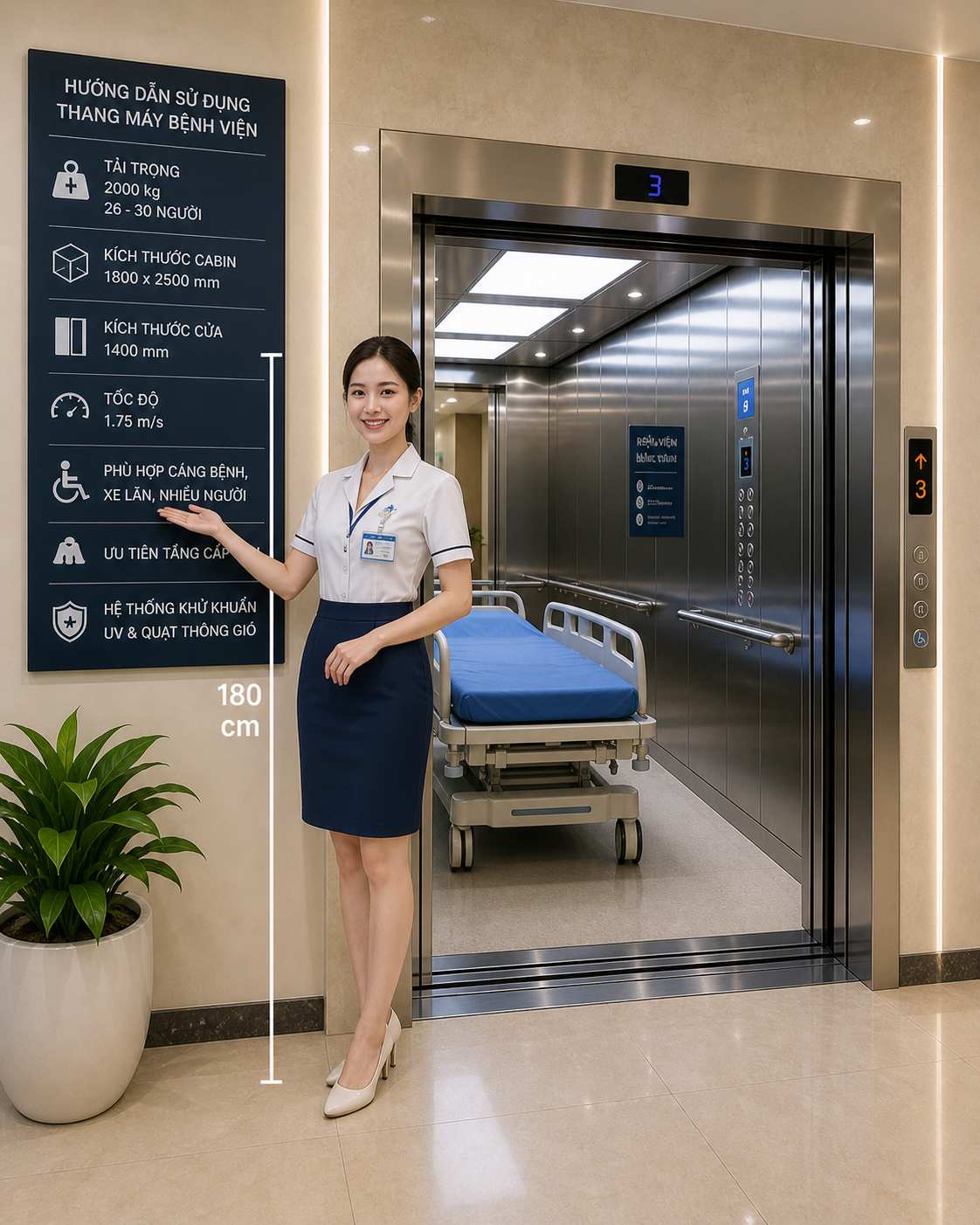
- Hospitals and healthcare facilities: Ensure the rapid and safe transportation of patients, healthcare workers, and medical equipment.
Design and installation requirements
Designing and installing a 3-door floor elevator requires close coordination between architects, mechanical and electrical engineers, and the construction contractor to ensure:
- Compatibility with building structure: Careful consideration is needed regarding the door placement, cabin dimensions, and rail system to avoid impacting the building's load-bearing structure.
- Safety assurance: Integrate safety devices and monitoring systems to prevent incidents during operation.
- Compliance with technical standards: Meeting national and international regulations for elevators, including standards for load capacity, speed, and rescue systems.
- Optimizing the user experience: Spacious cabin design, user-friendly controls, and strategically placed doors for user convenience.
- Maintenance and servicing: Develop a regular maintenance plan to ensure the elevator operates smoothly and to extend its lifespan.
Technical challenges
The implementation of a three-door floor elevator also faced several technical challenges, such as:
- Complex mechanical design: The door opening mechanism and rail system must be specially designed to ensure synchronized and safe operation.
- High investment costs: Due to the technical requirements and special materials, installation and maintenance costs are often higher than those of traditional elevators.
- Large space requirements: Although space-saving compared to multiple separate elevators, a three-door floor elevator still requires ample space to accommodate the door system and cabin.
- Operational complexity: The control system needs to be intelligently programmed to manage passenger flow and avoid conflicts when multiple doors open simultaneously.
Specifications of a 3-door floor elevator
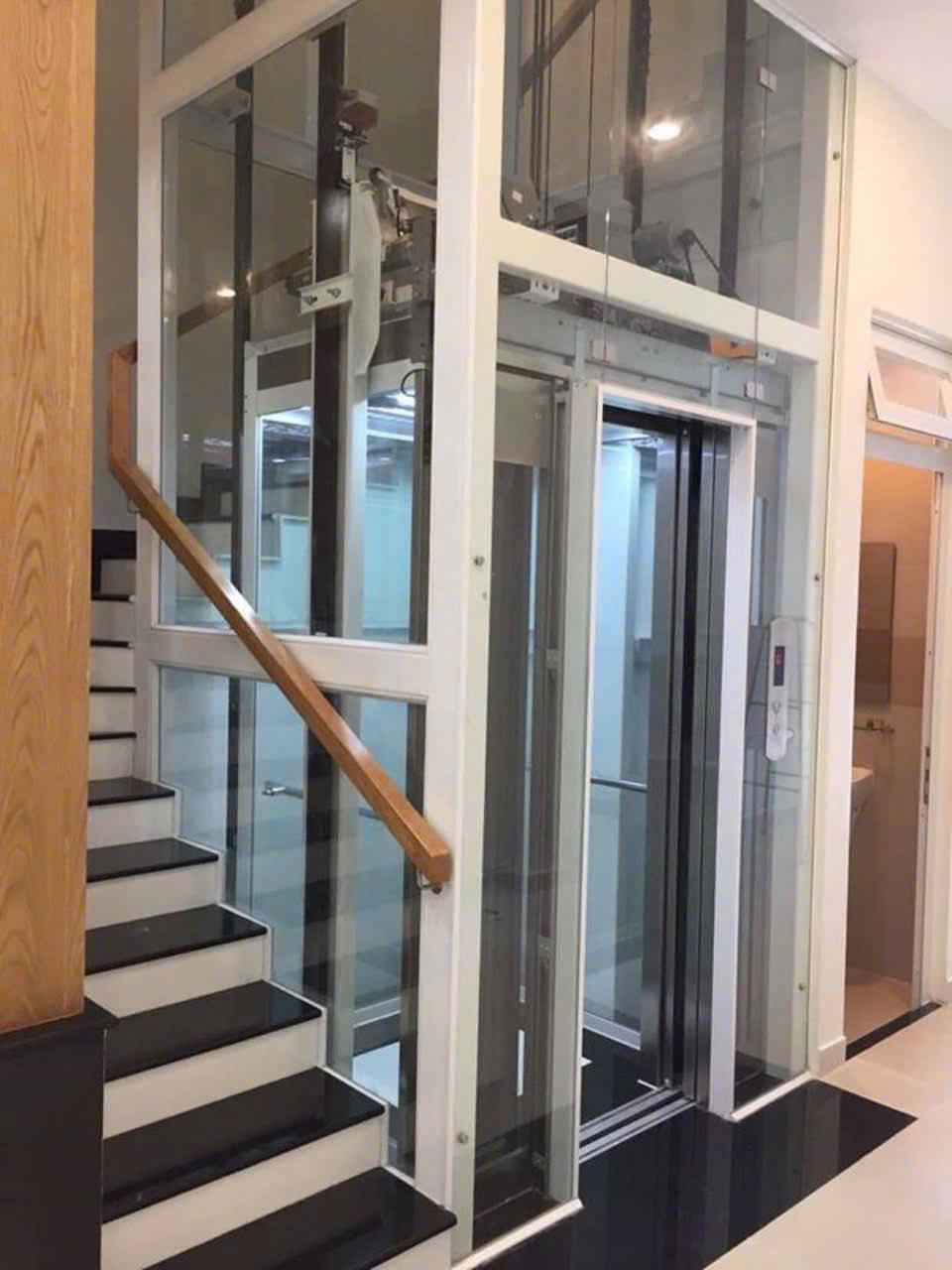
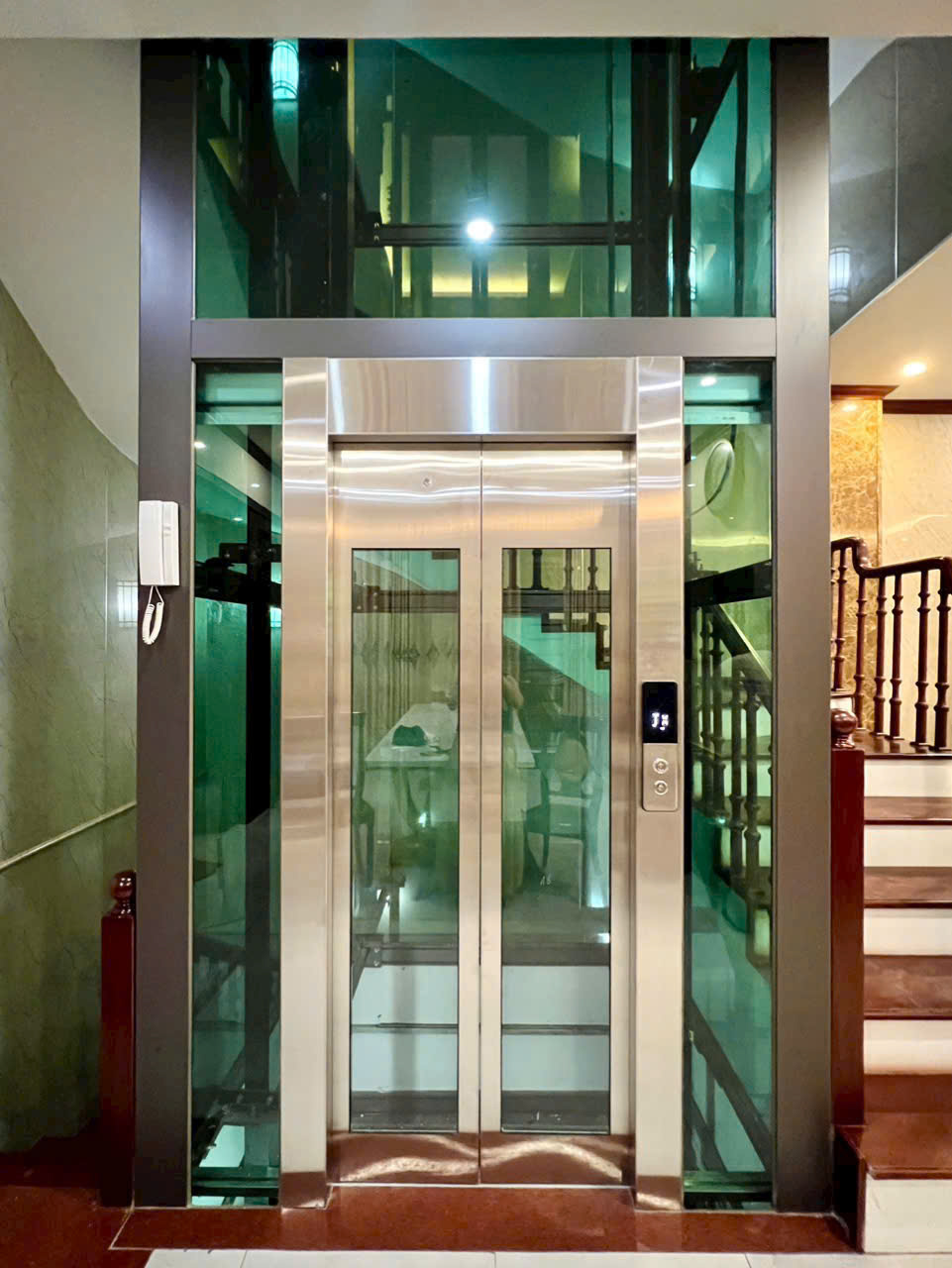
The 3-door floor elevator is designed with many advanced technical features to ensure stable, safe, and energy-efficient operation. This product belongs to the machine-roomless steel-frame glass elevator series, suitable for modern architectural projects requiring high aesthetics and space saving.
Elevator type: Steel-framed glass elevator, machine roomless design minimizes construction area and increases installation flexibility. The machine roomless design also contributes to reduced noise and enhances the building's aesthetics.
The model number: P450kg-CO70-03STOP-FUJI HP clearly indicates the load capacity, number of doors per floor, and the brand of the Japanese FUJI motor, guaranteeing high quality and durability.
Year of manufacture: 2026 - 100% brand new, guaranteed to use the most modern technology and components, meeting the latest safety and performance standards on the market.
Load capacity: 450 kg, equivalent to 6 people, suitable for residential buildings or small offices, ensuring efficient and safe transportation.
Speed: 60 m/min, a moderate operating speed, balancing efficiency and safety, suitable for medium and low-height structures.
Number of floor doors: 3 doors, specially designed to allow opening on three different sides of the cabin, increasing convenience and flexibility in floor space arrangement.
The clear opening dimensions of the elevator shaft (width x depth) are 1600 x 1800 mm. These dimensions ensure sufficient space for the cabin and operating equipment, while also complying with current construction standards.
Cabin dimensions (width x depth x height): 1150 x 1200 x 2300 mm. The cabin design is spacious and comfortable for users, while the 2300 mm height creates a feeling of open and airy space.
Elevator door dimensions (width x height): Center opening door 700 x 2100 mm. The large door size facilitates easy entry and exit, meeting safety standards and providing convenience for users, even when carrying large luggage or equipment.
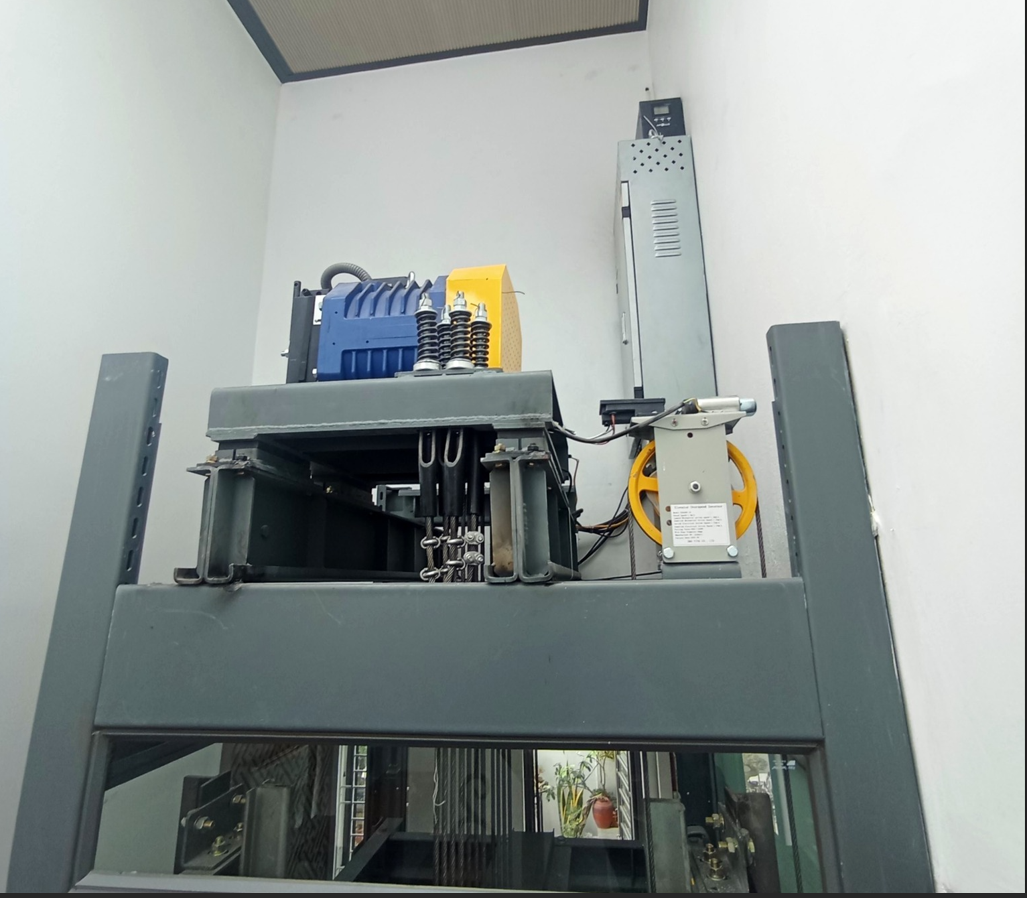
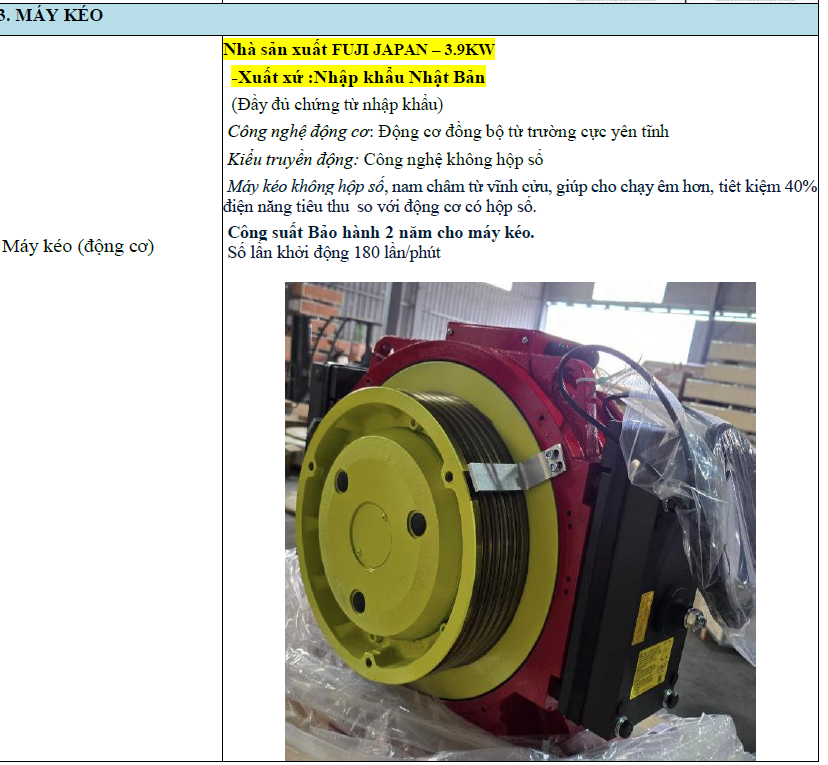
Motor: FUJI JAPAN, 3.9KW power, imported from Japan, using advanced technology for smooth operation, energy efficiency, and extended equipment lifespan. FUJI motors are renowned for their durability and high performance, suitable for projects requiring continuous operation.
Control cabinet: FUJI JAPAN, 8.3KW power, imported from Japan, integrated with an intelligent control system, capable of self-diagnosing faults and optimizing operation, ensuring absolute safety for users.
Lighting power supply: 1 Phase - 220V - 50 Hz, providing stable power to the cabin's interior lighting system, ensuring sufficient light and saving energy.
Power supply: 3 Phase - 380V - 50 Hz, providing a powerful power source for the motor and main operating equipment, ensuring the performance and durability of the elevator.
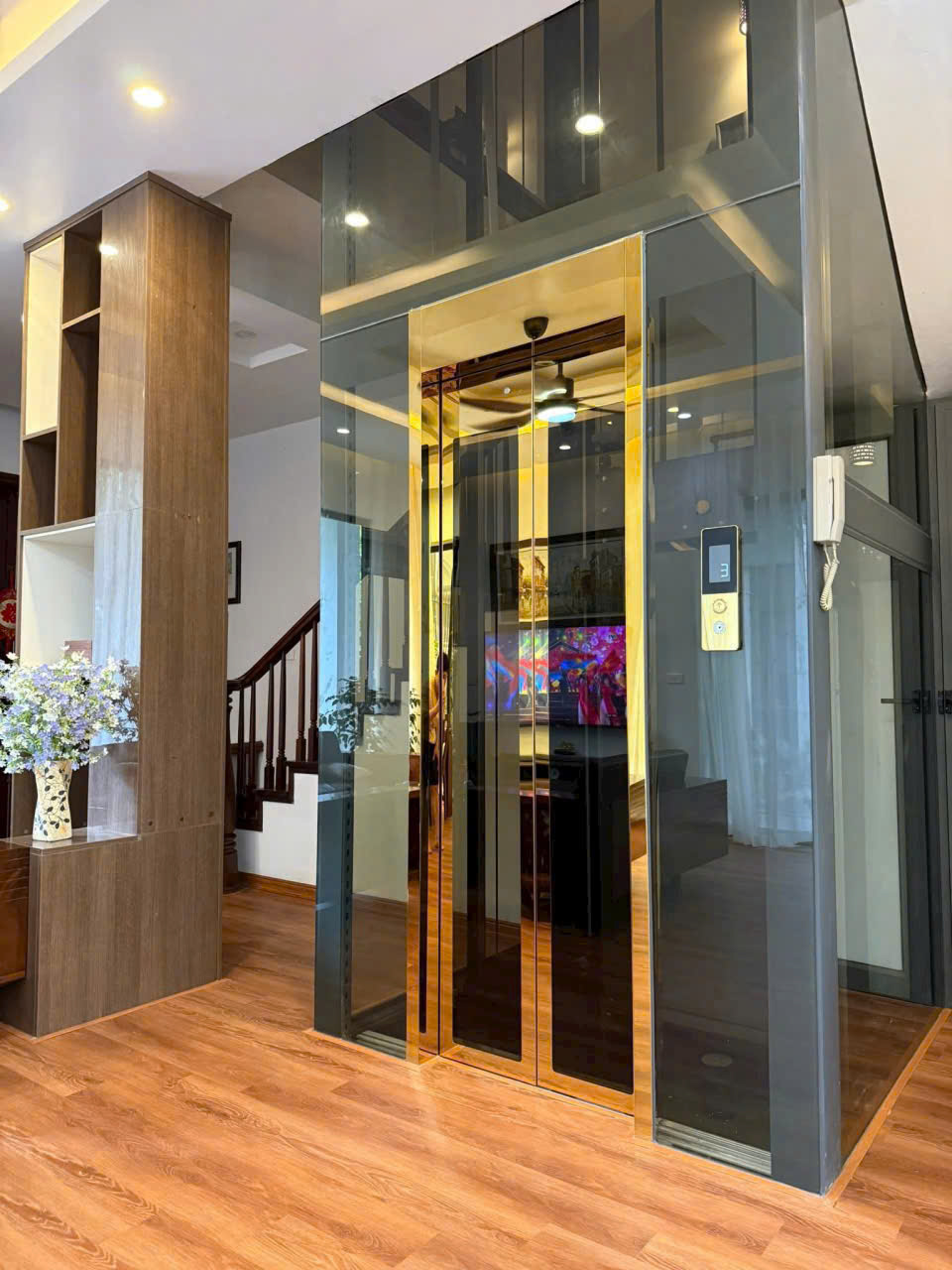
Elevator shaft steel frame: 50x120x120x50 steel profiles, 4mm thick, powder-coated in standard coffee or gray colors. The steel frame is designed to be sturdy, strong, corrosion-resistant, and aesthetically pleasing for the entire elevator shaft.
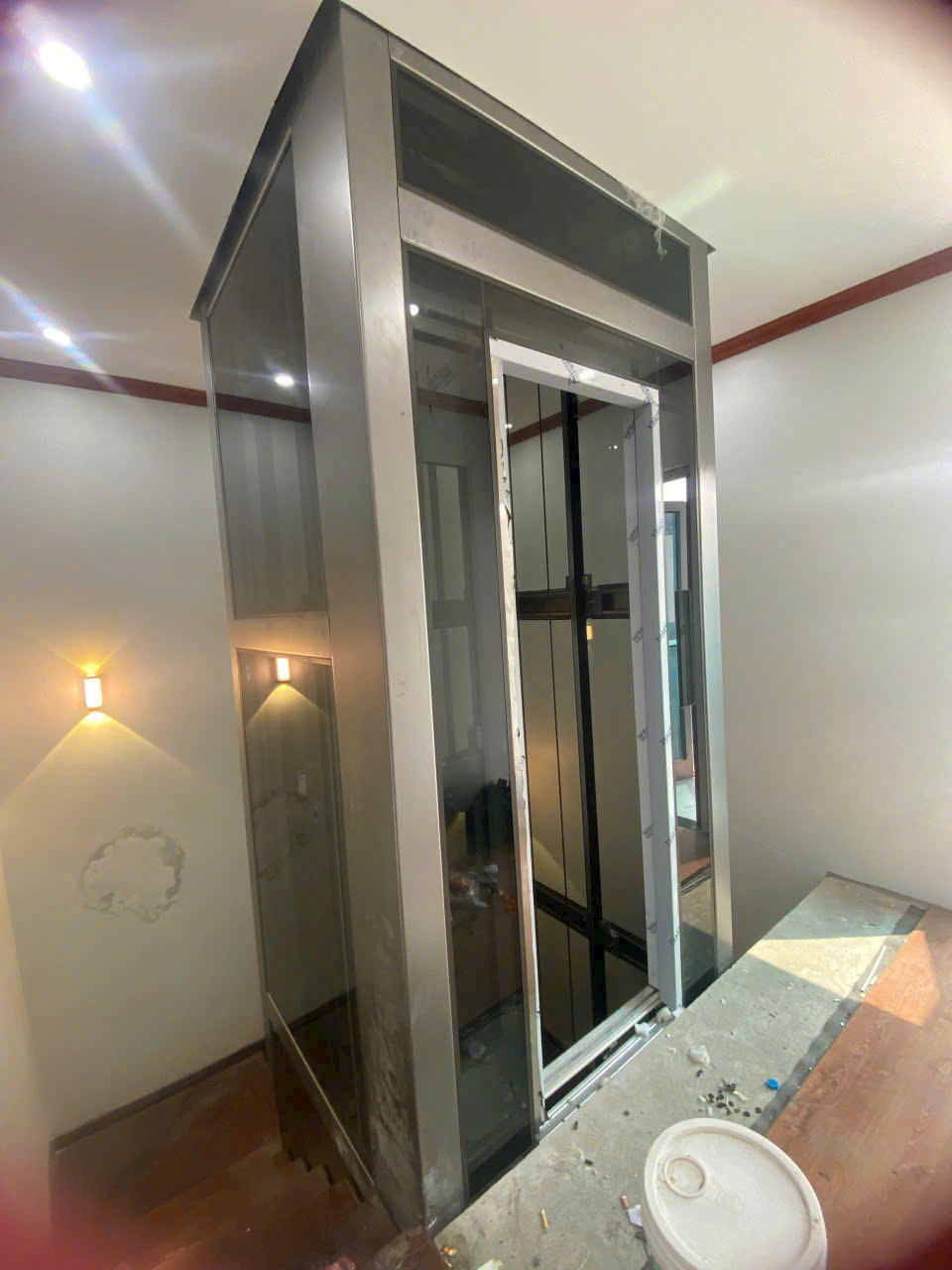
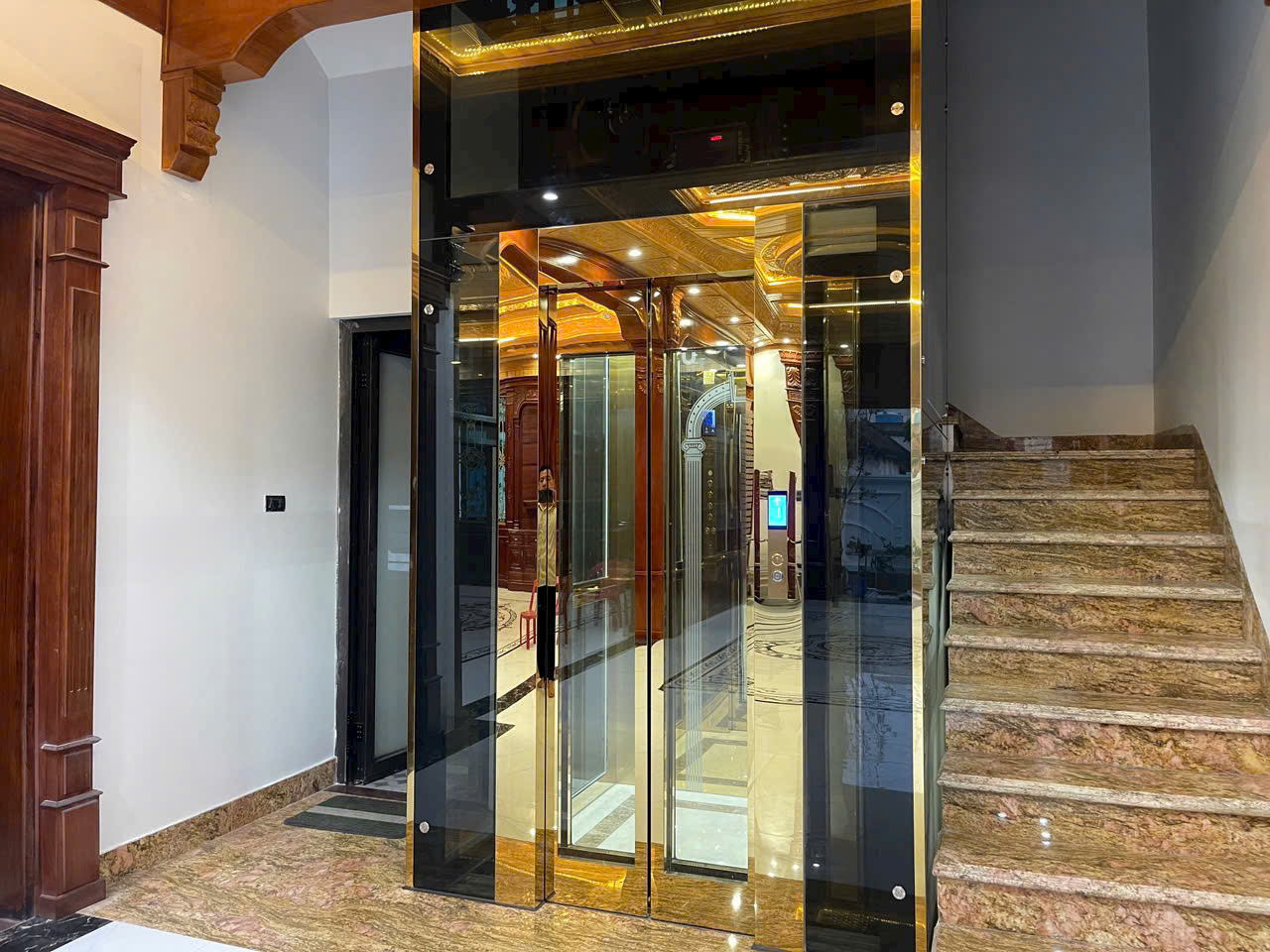
Elevator shaft cladding: 8.38mm thick, double-layered safety laminated glass, ensuring high mechanical strength, impact resistance, and user safety. The transparent glass enhances the sense of spaciousness and creates a modern focal point for the building.
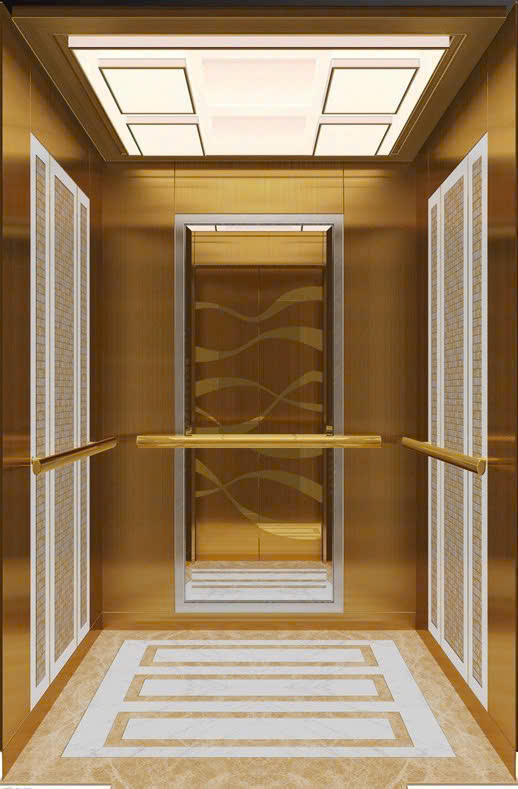
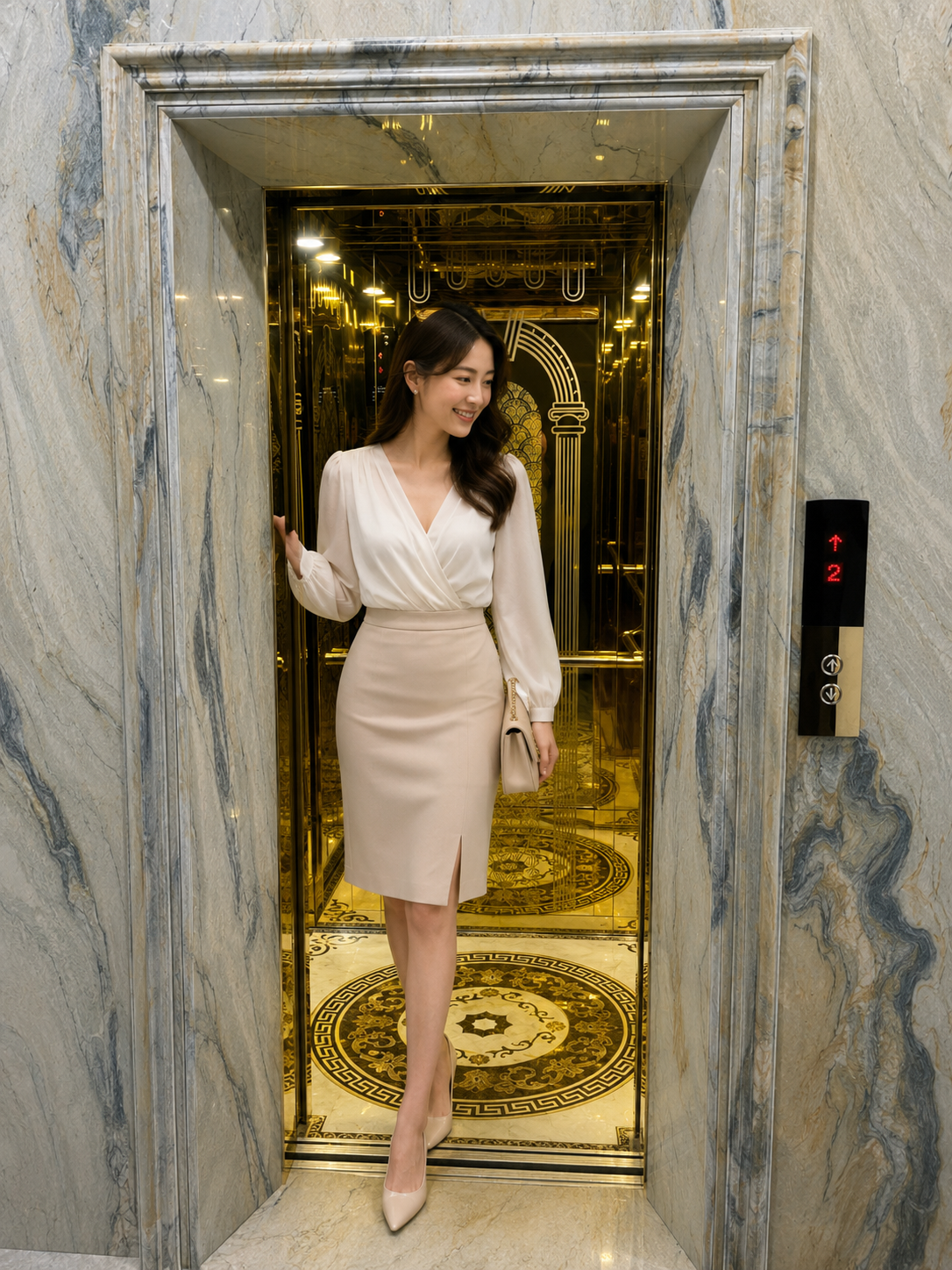
Cabin walls: White brushed stainless steel interspersed with white mirror-finish SUS304 stainless steel panels. SUS304 stainless steel is rust-resistant, easy to clean and maintain, and provides a luxurious and modern look to the elevator cabin.
Other notable technical features:
- Safety system: Includes speed limiter, safety brake, automatic door sensors, automatic power outage rescue system, ensuring absolute safe operation.
- Energy saving: Using asynchronous motors and inverter control systems helps reduce power consumption and is environmentally friendly.
- Machine room-free design: Saves construction space, reduces investment and maintenance costs, while also reducing noise and enhancing the aesthetics of the building.
- Customization options: Door sizes, powder coating colors, and wall cladding materials can be customized to meet specific customer requirements, suitable for a wide range of construction projects.
- LED lighting system: Energy-saving, long lifespan, uniform light, creating a comfortable and safe environment for users.
- Ventilation system: Strategically designed to keep the cabin well-ventilated, preventing a stuffy feeling during use.
| Category | Parameter |
|---|---|
| Type of ladder | Steel-framed glass elevator, no machine room. |
| Code | P450kg-CO70-03STOP-FUJI HP |
| Year of manufacture | 2026 - brand new |
| Load | 450 kg (6 people) |
| Speed | 60 m/min |
| Number of doors on each floor | 03 |
| Elevator shaft dimensions (width x depth) | 1600 x 1800 mm |
| Cabin dimensions (width x depth x height) | 1150 x 1200 x 2300 mm |
| Elevator door dimensions (width x height) | Center opening door 700 x 2100 mm |
| Engine | FUJI JAPAN, 3.9KW power, imported from Japan. |
| Control cabinet | FUJI JAPAN, 8.3KW power, imported from Japan. |
| Lighting power source | 1 Phase - 220V - 50 Hz |
| Power source | 3 Phase - 380V - 50 Hz |
| Steel frame for elevator shaft | Steel sheet 50x120x120x50, 4mm thick, powder coated in standard coffee and gray colors. |
| Elevator shaft wall cladding | 8.38mm thick double-layered laminated safety glass |
| Cabin wall | Fine white striped stainless steel interspersed with white mirror-finish SUS304 stainless steel sheets. |
Price list for 3-door glass elevators
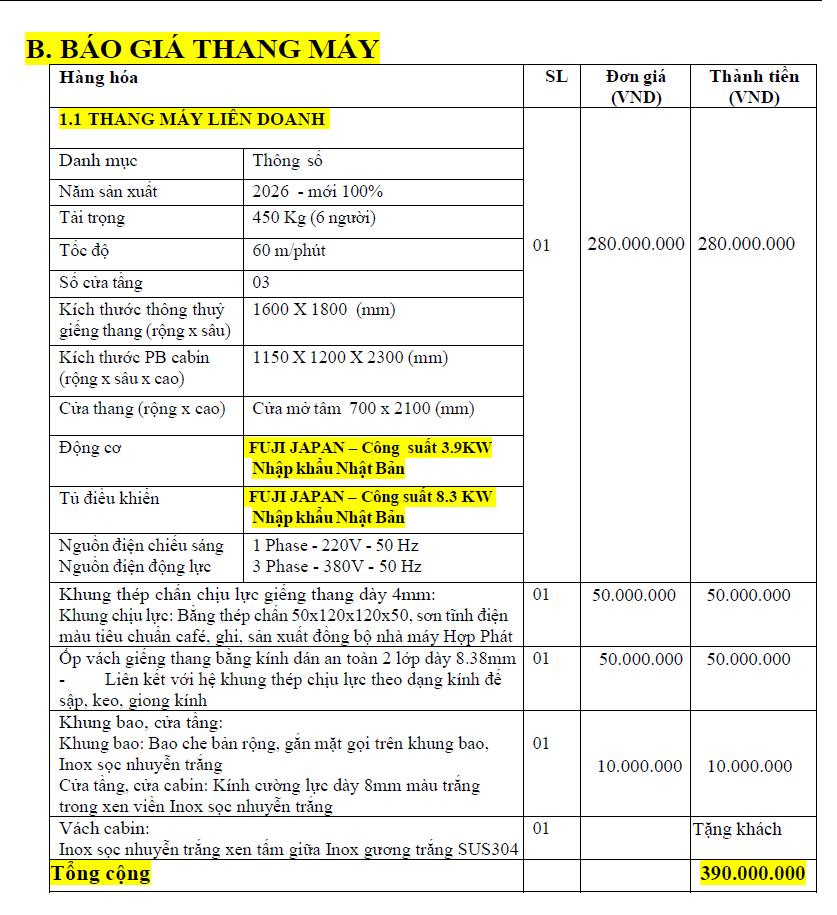
Detailed structure and applied technology
The 3-door elevator is designed with a sturdy, load-bearing steel frame, using 4mm thick steel and coated with anti-corrosion electrostatic paint , ensuring long-lasting durability and aesthetics. The elevator shaft uses double-layered safety laminated glass, increasing load-bearing capacity while ensuring user safety. The 3.9KW FUJI JAPAN traction motor utilizes magnetic synchronization technology to save energy, operate smoothly, and reduce noise. The gearless drive system optimizes efficiency and is environmentally friendly. The intelligent control system integrates VVVF and CAN Bus technology, allowing for stepless speed adjustment, precise floor stopping, energy saving, and enhanced operational safety thanks to modern sensors.
Elevator frame and shaft
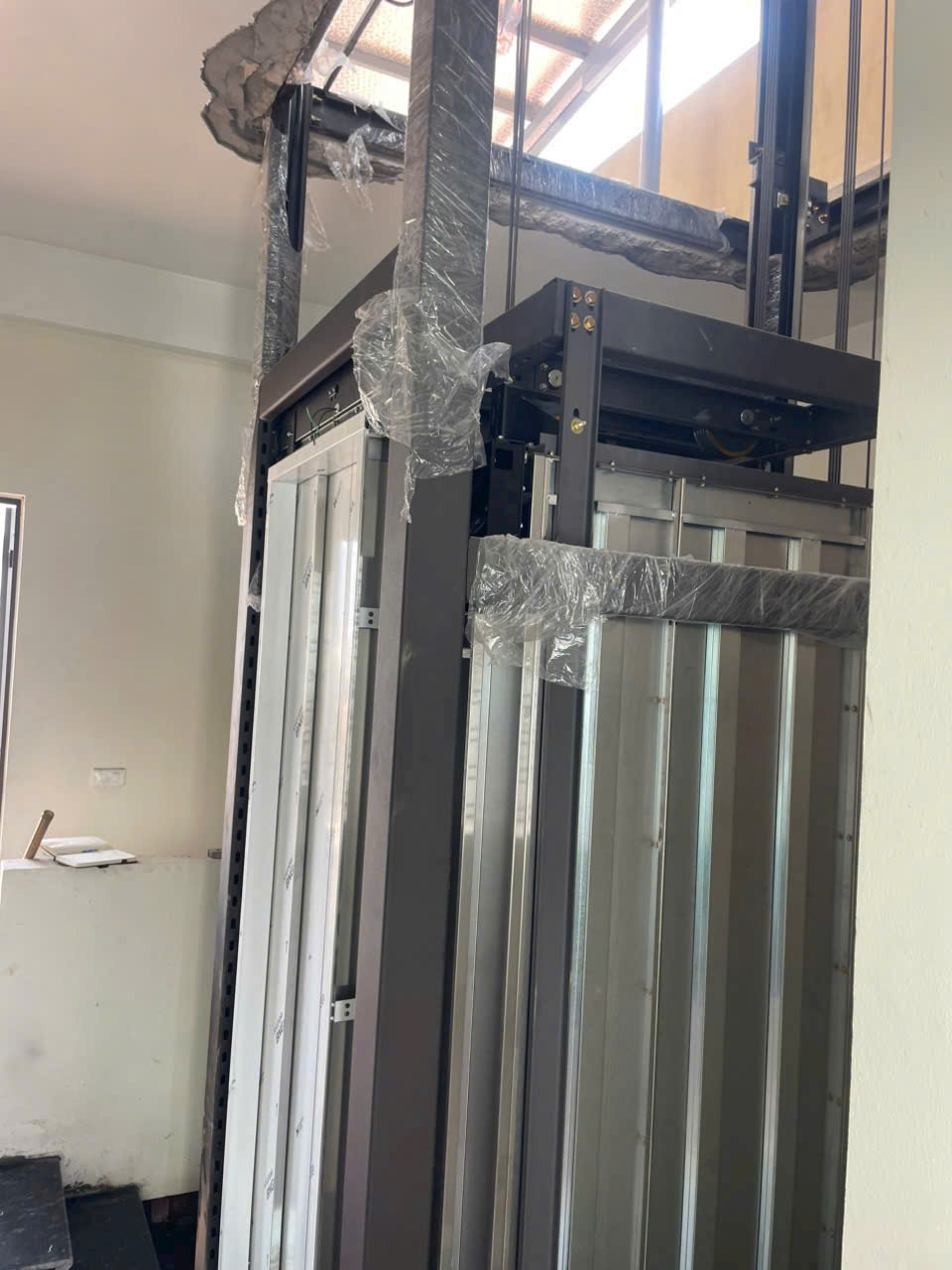
The steel frame is the main component in the structure of the 3-door floor elevator, ensuring load-bearing capacity and operational stability. The frame is constructed from 4mm thick channel steel, with steel bars measuring 50x120x120x50 mm, designed in a rectangular box shape to optimize bending and compressive strength. The use of channel steel enhances rigidity and minimizes deformation under dynamic and static loads during elevator operation.
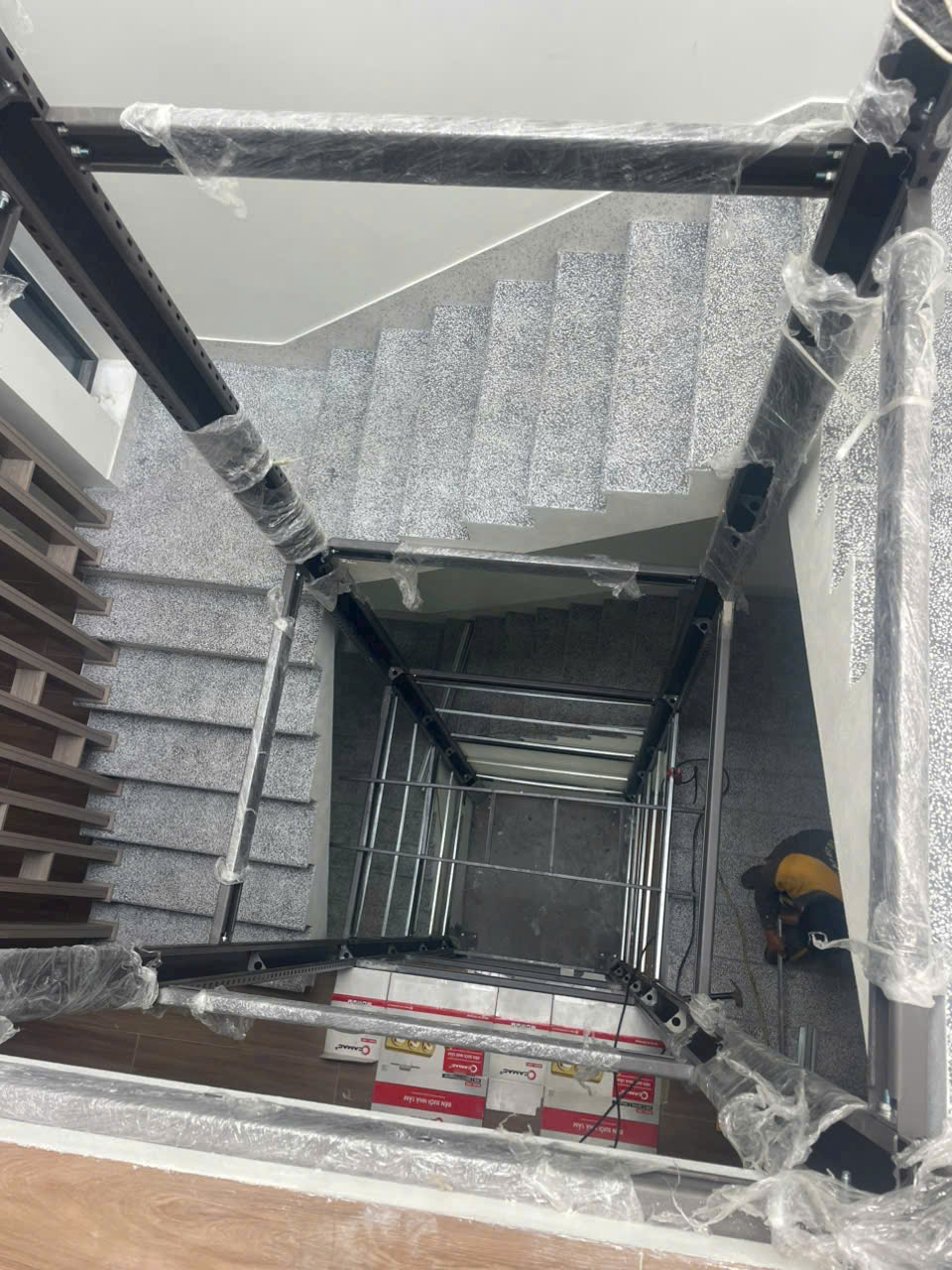
The entire steel frame is surface-treated using electrostatic powder coating technology with standard colors such as coffee or gray. Electrostatic powder coating not only enhances aesthetics but also creates an effective protective layer against corrosion and oxidation in humid or chemically-laden environments. The electrostatic powder coating process ensures a strong, even coating, extending the lifespan of the steel frame for many years.
The elevator shaft is designed with a double-layered safety laminated glass cladding, with a total thickness of 8.38mm. Safety laminated glass is a type of tempered glass combined with a PVB (Polyvinyl Butyral) film in the middle, ensuring that when the glass breaks, it remains intact and does not create sharp shards that could endanger users. This is an optimal safety solution for buildings with high aesthetic and safety requirements.
Advantages of laminated safety glass in elevator shafts:
- Increased resistance to impact and wind pressure.
- Minimize the risk of injury when glass breaks.
- Enhance natural light, creating a spacious and modern atmosphere.
- Easy to clean and maintain, preserving its beauty for a long time.
Engine and drivetrain
The elevator uses a FUJI JAPAN 3.9KW traction motor , directly imported from Japan, featuring Permanent Magnet Synchronous Motor (PMSM) technology. This type of motor does not use a traditional gearbox, reducing mechanical friction, increasing transmission efficiency, and minimizing operating noise.
PMSM motors have outstanding technical characteristics:
- High power conversion efficiency, saving approximately 40% of electricity compared to motors with gearboxes.
- Smooth operation, reduced vibration and noise, enhancing the user experience.
- Equipment lifespan is extended due to reduced mechanical wear and tear.
- Precise speed control capabilities, suitable for diverse operating requirements.
The gearless drive system utilizes permanent magnets to increase power transmission efficiency, reduce energy loss, and protect the environment. With an operating speed of 60 m/min, it is suitable for small and medium-sized civil and commercial buildings, ensuring fast and safe passenger transport.
Intelligent control system
The elevator control system is equipped with an 8.3KW FUJI JAPAN microprocessor , integrating VVVF (Variable Voltage Variable Frequency) technology . This technology allows for stepless adjustment of the output voltage and frequency of the traction motor, enabling flexible elevator speed control, reducing shock during starting and stopping, thereby enhancing smoothness and safety during operation.
Key features of the intelligent control system:
- Stepless speed adjustment: Helps the elevator operate smoothly, reducing vibration and noise.
- Precise floor stopping: Ensure the cabin stops at the correct floor, facilitating passenger boarding and alighting.
- Energy saving: Optimizing power consumption and reducing operating costs.
- CAN Bus technology: A modern digital signal transmission system that allows for fast and stable data transmission between control devices and sensors.
- Priority call processing: Automatically detects direction of movement and prioritizes serving appropriate calls, reducing waiting times.
- LED/LCD display: Shows operating status, error messages, and safety functions, making it easy for users to monitor.
- Safety features include canceling unnecessary calls, automatically stopping at a safe floor upon detecting an incident, and protecting passengers and equipment.
The intelligent control system also integrates modern sensors and monitoring devices such as overload sensors, door sensors, and speed sensors, helping to detect and handle abnormal situations promptly, ensuring continuous and absolutely safe operation.
Design of elevator cabin and doors for 3 floors.
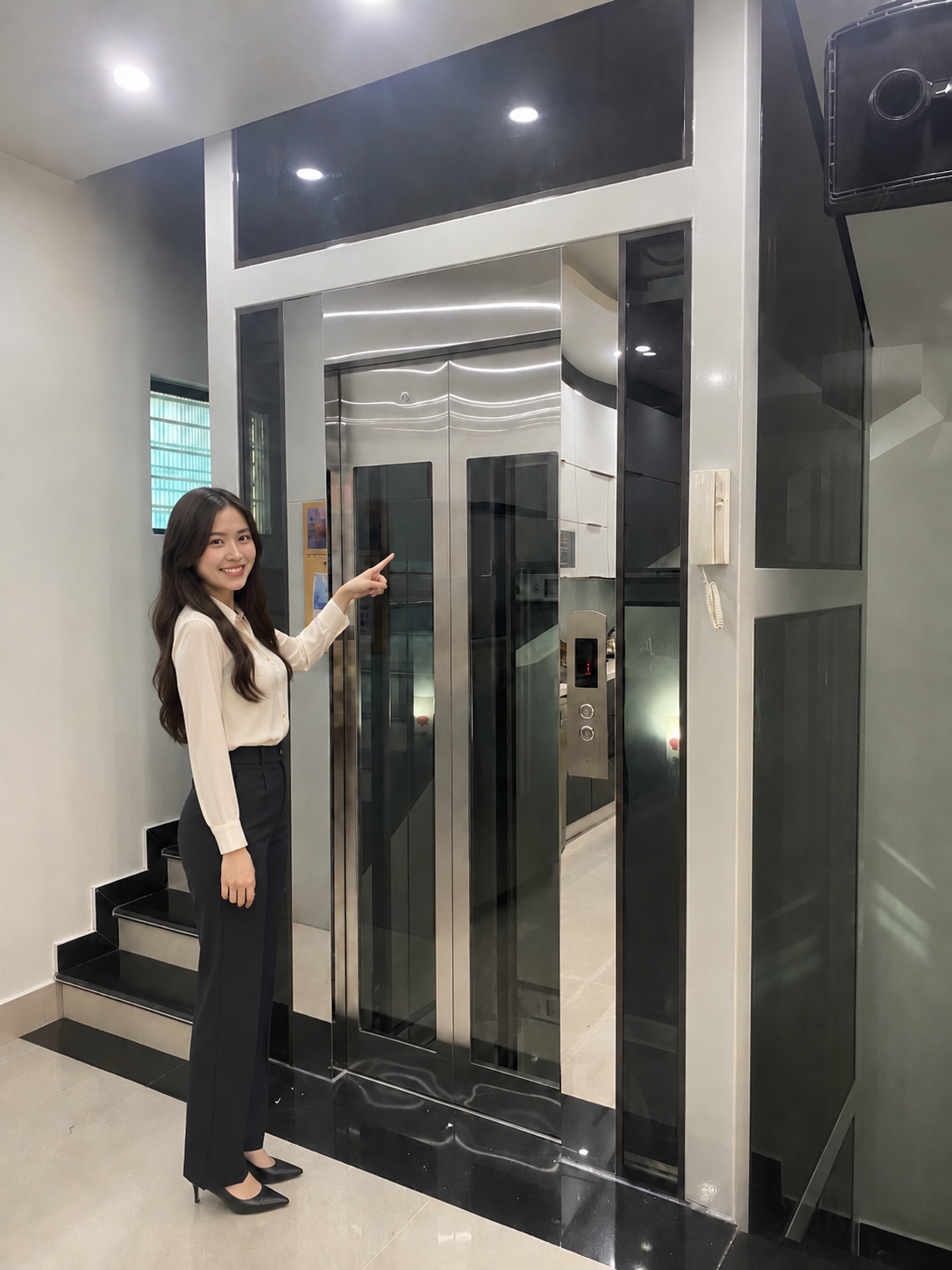
The 3-door elevator cabin is constructed from high-grade SUS304 stainless steel, combining brushed stainless steel and mirror-finish stainless steel to create a spacious, modern, and durable space. The cabin walls are meticulously crafted with stainless steel bolts for increased rigidity and ease of maintenance. The cabin floor uses imported granite with scratch-resistant and anti-slip properties, while the ceiling combines mirror-finish stainless steel and high-grade acrylic for soft, pleasant lighting. Ergonomic stainless steel handrails and a ventilation fan ensure user safety and comfort.
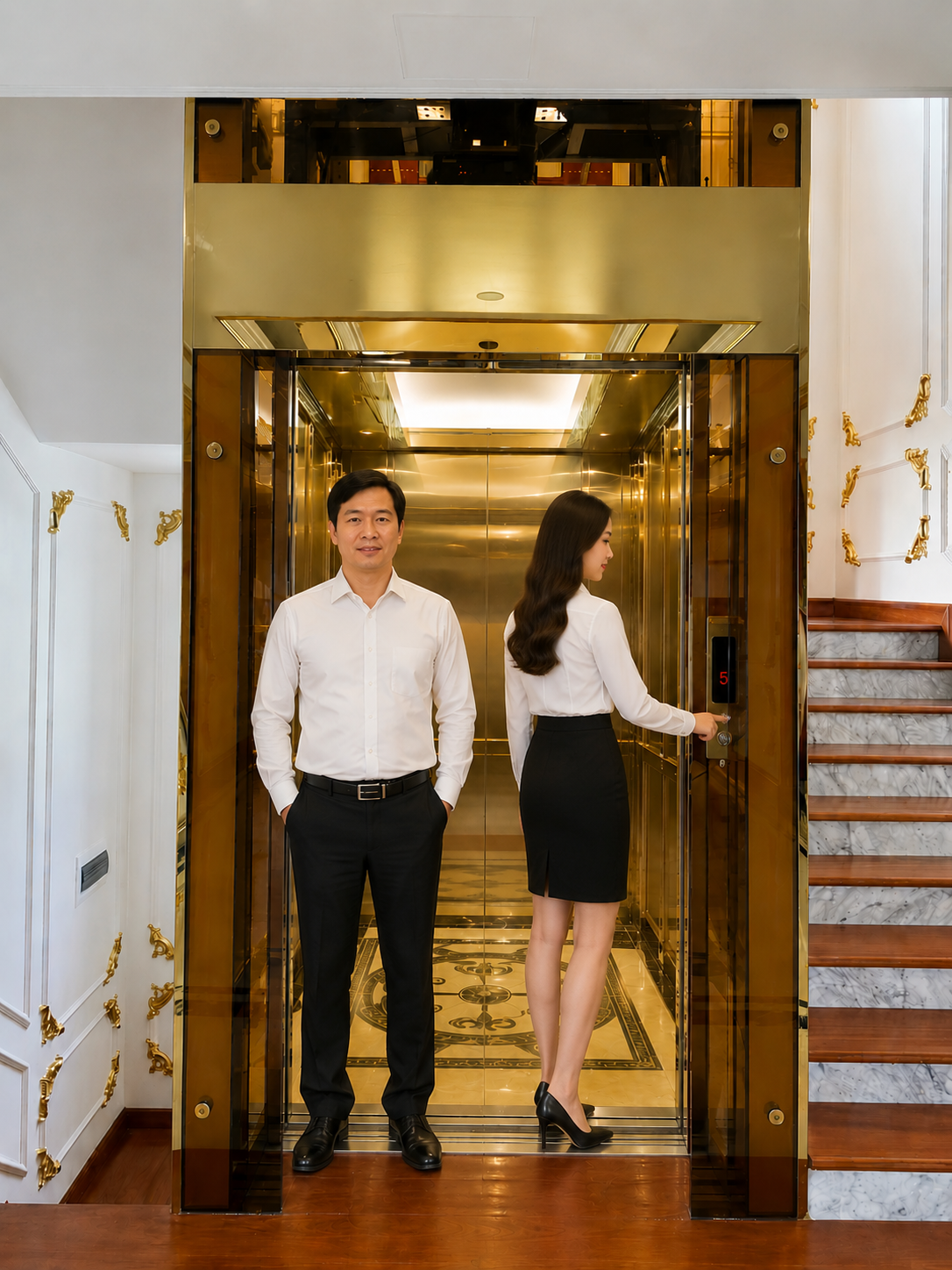
The 2-door automatic cabin doors are made of SUS304 stainless steel with a modern motor drive system, ensuring smooth and safe operation thanks to obstacle detection sensors. The landing doors use 8mm thick tempered glass combined with finely striped stainless steel trim, enhancing aesthetics and durability. The stainless steel frame and extruded aluminum guide rails ensure smooth operation, reducing noise and friction. The combination of high-quality materials guarantees superior performance and longevity for this 3-door landing elevator.
Elevator cabin
The 3-door elevator cabin is designed to high technical standards, using top-quality SUS304 stainless steel, ensuring superior mechanical durability and corrosion resistance in continuous operation. The three cabin walls are constructed from brushed stainless steel alternating with white mirror-finish stainless steel panels, creating a balance between aesthetics and light reflection, making the cabin space feel more spacious and modern.
The cabin wall panels are fabricated using a precision-folding method, then securely joined with stainless steel bolts, enhancing overall rigidity and impact resistance. The use of bolts instead of welding facilitates easy disassembly, maintenance, and replacement when needed, while minimizing the risk of thermal deformation during processing.
The cabin floor is paved with granite imported from Vietnam, which is highly durable, scratch-resistant, and strong. Customers can choose from a diverse catalog of granite patterns and colors to match the overall design style of the building. Granite not only enhances aesthetics but also ensures safety by preventing slips thanks to its specially treated anti-slip surface.
The cabin ceiling is designed with a combination of mirrored stainless steel and high-quality acrylic panels, creating a soft and even lighting effect. The acrylic panels have excellent light diffusion capabilities, reducing glare and creating a comfortable feeling for users. The integrated LED lighting system inside the cabin ceiling can be customized in color and intensity as required, meeting elevator lighting standards.
The handrails inside the cabin can be chosen in round or flat shapes, made from SUS304 stainless steel, and ergonomically designed for easy gripping, enhancing safety during elevator operation. In addition, a dedicated ventilation fan is installed to maintain air circulation, prevent stuffiness, and increase passenger comfort throughout the journey.
Cabin doors and landing doors
The 3-door elevator cabin door is a 2-leaf automatic door that opens from the center, with standard dimensions of 700 mm wide and 2100 mm high, suitable for a variety of elevator types and usage requirements. The door is made of 1.2mm thick SUS304 stainless steel, with the option of a mirrored or brushed stainless steel surface depending on the design style and aesthetic requirements of the project.
The door drive system utilizes a high-tech motor capable of precisely controlling the opening/closing speed, ensuring smooth, fast operation without sudden jerks. This drive mechanism is also equipped with safety sensors that detect obstacles and automatically stop or reverse the door closing direction, providing absolute safety for users.
The landing doors are designed with 8mm thick tempered glass in a clear white color, combined with a fine white striped stainless steel trim to create an aesthetic accent and enhance durability. Tempered glass not only ensures high impact resistance but also resists scratches and is easy to clean, maintaining its beauty for a long time in a public environment.
The door frame is made of brushed white stainless steel, with a suitable width to protect the entire door system and increase stability during operation. The door bottom guide rail uses high-precision shaped aluminum, ensuring smooth door operation, reduced friction, and noise during opening and closing.
The combination of SUS304 stainless steel, tempered glass, and extruded aluminum in the design of the cabin and landing doors not only ensures aesthetics but also enhances the lifespan and operational efficiency of the 3-door landing elevator, meeting stringent safety and technical standards in the modern elevator industry.
Safety and convenience features included
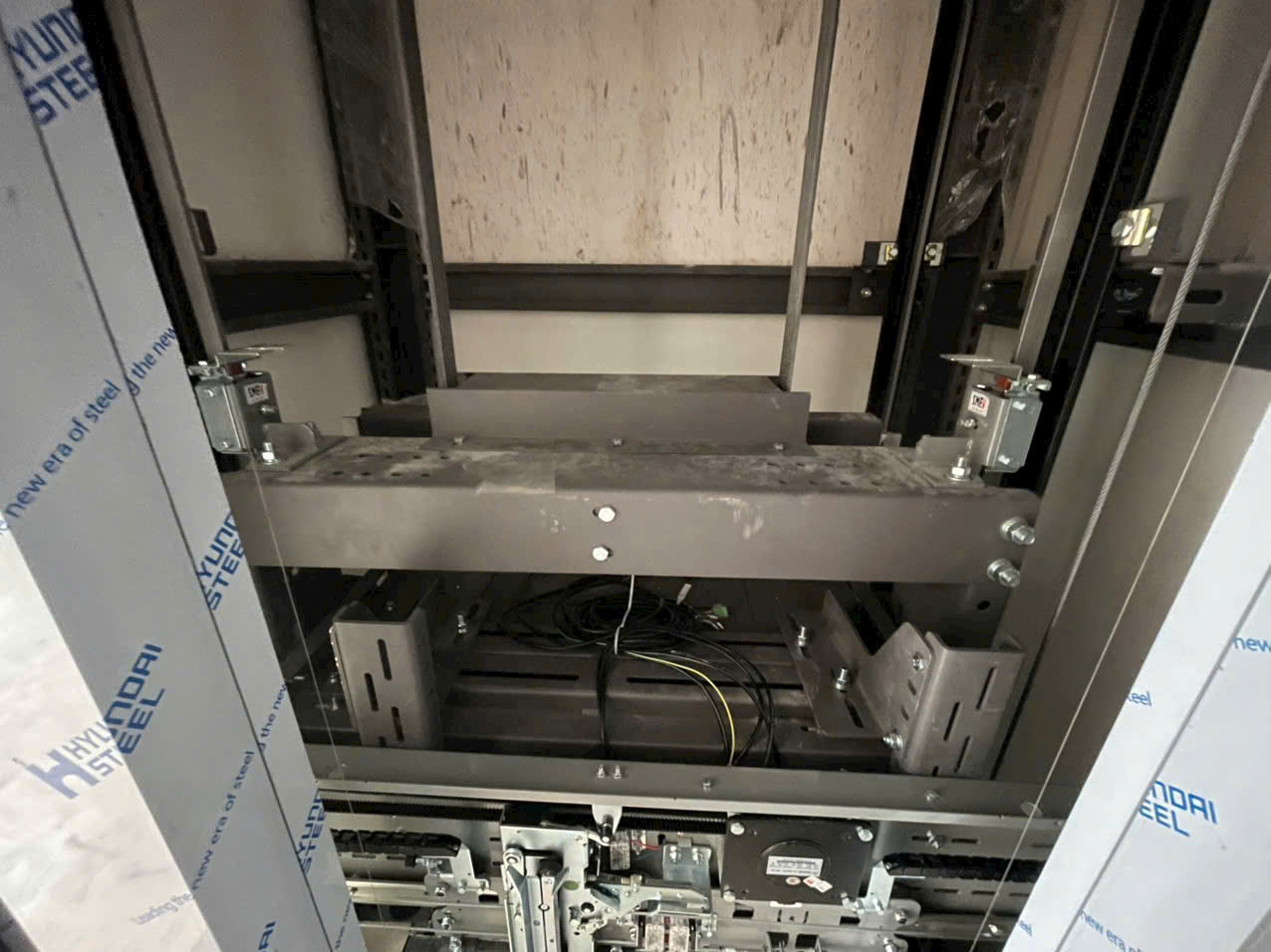
The safety system of the 3-door floor elevator is equipped with many advanced protective devices such as speed control , safety brakes , shock absorbers , and overtravel switches , ensuring stable operation and maximum safety for users. At the same time, electrical protection devices and overload sensors help maintain performance and extend equipment lifespan.
In terms of operational convenience, the system integrates intelligent functions such as automatic cancellation of redundant calls , independent service from inside the elevator cabin , safe floor stopping , and automatic door speed adjustment . Features such as repeated door reopening and closing with advanced sensors also contribute to enhancing the user experience and ensuring absolute safety during use.
Safety equipment
The 3-door floor elevator is designed with a multi-layered safety system to ensure stable operation and maximum protection for users and equipment. All integrated safety devices comply with international standards and strict regulations in the elevator industry.
- The speed controller (Governor): This is a crucial mechanical device installed on the top floor of the technical building. It uses a centrifugal disc to monitor the cabin speed. When the cabin speed exceeds the pre-set safety limit, the controller automatically activates the braking mechanism, allowing the cabin to decelerate and stop safely, preventing the risk of free fall or uncontrolled acceleration.
- Safety Brake: Mounted directly under the cabin frame, the safety brake locks the cabin on the guide rails in the event of an incident such as a cable break or sudden power failure. This device operates independently of the main braking system, ensuring the cabin does not slide or fall freely, thus protecting the lives of the occupants.
- Buffer: Located at the bottom of the pit, the damper absorbs the impact force when the cabin or counterweight moves down suddenly. Common types of dampers include hydraulic or spring dampers, which minimize damage to the cabin and pit structure, while also enhancing the system's durability.
- Overload warning device: A load sensor system is installed in the cabin to continuously monitor the weight of passengers and goods. When the load exceeds the permissible limit, the device will activate an alarm and prevent the elevator from operating, avoiding damage to the motor and mechanical parts due to overload.
- Limit Switch: This is a mechanical or electronic switch located at the travel limits of the cabin and counterweight. When the cabin moves beyond its defined travel limit, the switch will cut off the power supply or activate the safety braking system, preventing accidents caused by the cabin exceeding the limit.
- Electrical protection devices: This system includes components such as overload protection relays, phase loss protection, reverse phase protection, and phase drop protection. They help protect the motor and control electronics from electrical faults, ensuring stable elevator operation and extending equipment lifespan.
Smart operating utilities
The 3-door floor elevator control system incorporates many smart features, enhancing user experience and optimizing operational efficiency.
- Automatic cancellation of redundant calls: When multiple calls are made to the same floor or in the same direction, the system automatically removes redundant calls, reducing the load on the controller and shortening passenger waiting times. This feature optimizes the cabin's travel path, saves energy, and increases operational efficiency.
- Independent service from inside the elevator cabin: In special situations such as maintenance or priority operation, the elevator can be switched to independent service mode, only accepting calls from inside the cabin. This allows for tighter control over the operation process and ensures the safety of technicians or special users.
- Safe floor stop: When the elevator malfunctions and stops midway between floors, the control system will automatically check the cabin's position and move it to the nearest floor to open the doors safely. This feature helps users escape quickly and minimizes the risk of being trapped inside the cabin.
- Automatic door speed adjustment: The sensor system and door controller continuously monitor real-world conditions such as cabin weight, ambient temperature, and usage frequency to adjust the door opening and closing speed accordingly. This not only enhances the durability of the door mechanism but also ensures passenger safety when entering and exiting the elevator.
- Reopening the door using the call button: If the door is closed but someone presses the call button or the door open button, the system will automatically reopen the door to let the passenger in. This feature increases convenience and minimizes the inconvenience or danger of doors slamming shut.
- Repeated door closing: When an obstruction is detected during elevator door closing, the system will automatically open the door and attempt to close it multiple times until the obstruction is removed. This feature utilizes advanced safety sensors such as infrared or pressure sensors, ensuring absolute safety for passengers, especially children and the elderly.
Warranty and maintenance policy for 3-door floor elevators
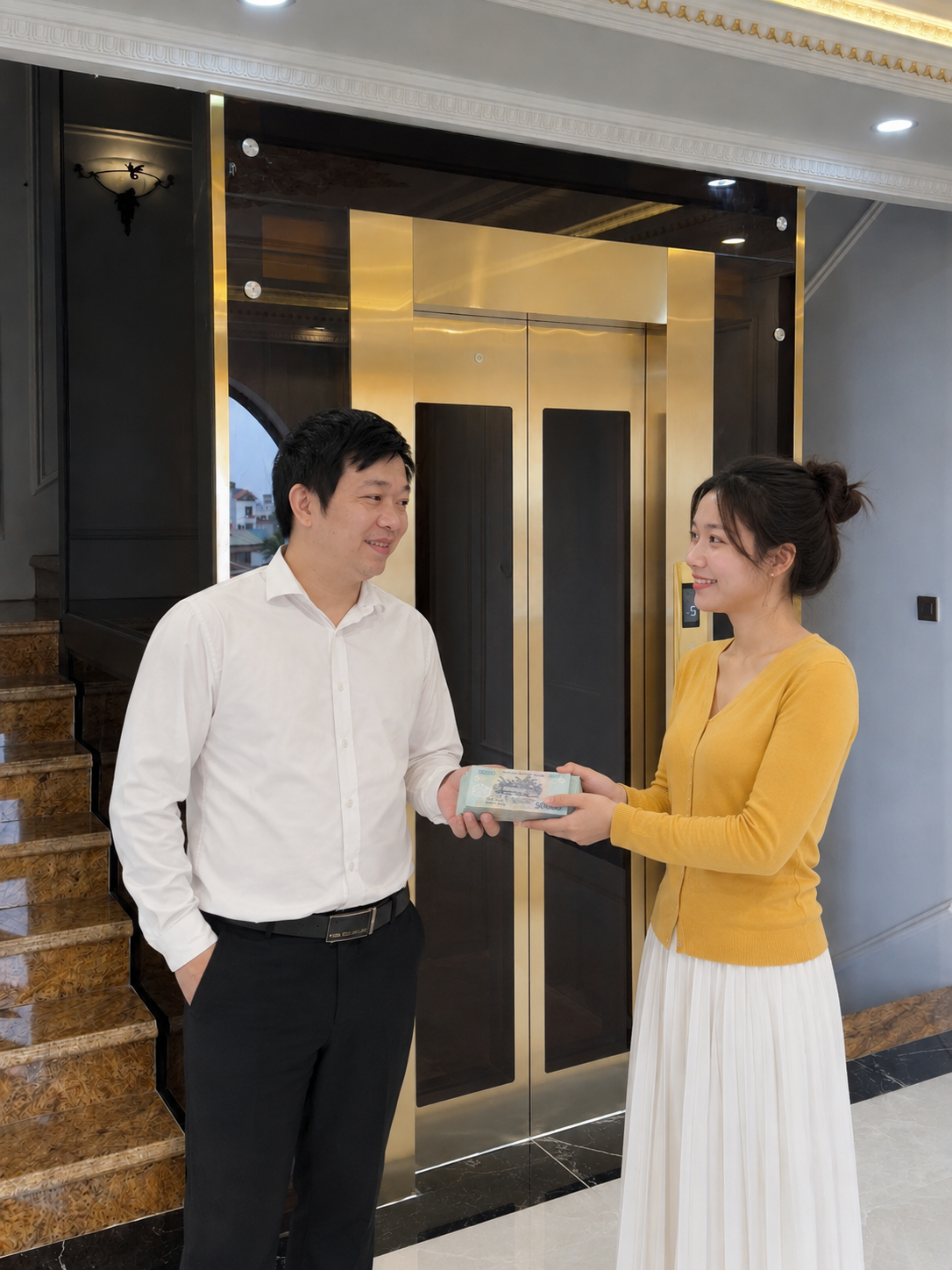
Ngoc Quyet General Construction & Trading Mechanical Co., Ltd. is committed to providing 3-door floor elevators with 100% new equipment, complete import documentation, and a 24-month manufacturer's warranty from the date of delivery. The warranty and maintenance policy is strictly implemented to ensure stable and safe long-term elevator operation, meeting international technical and safety standards.
Equipment warranty
All 3-door floor elevator equipment supplied by the company is genuine imported, with quality certifications and rigorous testing according to ISO 9001 and TCVN standards for elevators. The equipment includes:
- Motor and control system: Ensures power, efficiency, and durability according to design specifications.
- Landing doors and cabin doors: Automatic opening and closing mechanism, safety sensors, anti-jamming feature.
- Load-bearing cables and counterweights: Tested for load capacity, tensile strength, and abrasion resistance.
- Safety features include braking systems, speed sensors, and automatic rescue systems.
During inspection, acceptance testing, or use, if the equipment is found to be substandard or defective due to manufacturing faults, the company will replace or repair it free of charge. This ensures customer rights and maintains optimal elevator performance.
Maintenance work
Regular maintenance is crucial for maintaining the safety and lifespan of a 3-door floor elevator. During the 24-month warranty period, the company performs scheduled maintenance every two months, including specialized tasks such as:
- Conduct a comprehensive inspection of the electrical, mechanical, and control systems.
- Adjust the controller's technical parameters to ensure accurate operation.
- Clean the mechanical parts, removing dirt, dust, and excess grease that could affect their operation.
- Lubricate moving parts such as guide rails, wheels, and door hinges.
- Inspect and test safety devices such as door sensors, brakes, and rescue systems.
- Assess the condition of the load cables and counterweights, and detect early signs of wear or damage.
Each maintenance visit is documented in a written record signed between the company and the customer, clearly detailing the inspection items, equipment condition, and any recommendations. After the warranty period ends, customers can choose to sign a comprehensive maintenance contract with flexible service packages ranging from 1 to 10 years, ensuring the elevator always operates at its best, minimizing the risk of malfunctions and extending the equipment's lifespan.
Technical support services
The company's team of technicians is highly trained in 3-door floor elevators and has experience handling a wide range of technical issues. Technical support services are professionally organized with the following commitments:
- 24/7 Support: We are always available to receive requests and provide technical advice by phone or in person.
- Rapid response: Technicians will be on-site within 1 hour of receiving notification of the incident.
- Efficient troubleshooting: The majority of technical issues are resolved on-site, ensuring the elevator is back in operation as quickly as possible.
- Prompt replacement of parts: In case of component replacement, the company commits to a turnaround time of no more than 24 hours, and no more than 5 days for complex cases or specialized components.
- Direct support from the Board of Directors: Customers are provided with the Board of Directors' hotline number to contact when needed, ensuring that all issues are resolved promptly and transparently.
At the same time, the company applies a modern maintenance management system, using software to track maintenance schedules, repair history, and equipment status, helping customers easily control and plan appropriate maintenance.
Elevator user manual and operator training
To ensure absolute safety and improve the operational efficiency of 3-door floor elevators, in-depth training for operators is a prerequisite. This process not only helps operators master basic knowledge but also equips them with the skills to handle situations that may arise in practice. The training content is developed based on international technical standards and current occupational safety regulations, including:
- Safety principles for elevator construction and operation:
- Understand the basic structure of a three-door floor elevator, including the cabin, counterweight, cable system, control unit, and safety devices.
- Comply with occupational safety regulations during construction, installation, and maintenance, such as using personal protective equipment (PPE) and inspecting electrical systems before operation.
- Regularly inspect safety devices such as brakes, door sensors, and automatic rescue systems to ensure they are functioning properly.
- Clearly distinguish between warning signs of danger such as unusual noise, cabin vibration, or control system errors.
- Instructions for operating and using elevators correctly:
- Standard operating procedure: turn on the power, check the control panel, select the floor, and monitor the movement process.
- Instructions for using the control panel with function buttons such as floor call, door open/close, and emergency stop button.
- Safety operating principles: Do not exceed the permitted load capacity, and do not allow children or unauthorized persons to use the elevator alone.
- Explain the warning signals on the dashboard and how to respond appropriately.
- Emergency rescue procedures:
- Procedure for handling an elevator stuck between floors: remain calm, use the internal communication system to notify the technical department.
- Instructions on using rescue equipment such as manual door locks, emergency door release buttons, and tools to assist in cabin removal.
- Provide basic first aid training for people trapped in elevators, including how to stay safe and minimize stress.
- Coordinate with professional rescue teams in complex situations.
- Adjust and repair minor malfunctions during use:
- Identify common problems such as doors not closing properly, elevator shaking, and control system error messages.
- Instructions for checking and adjusting basic components such as door sensors, brakes, and cabin lighting systems.
- Perform minor maintenance tasks such as lubricating the guide rails, inspecting the load cables, and replacing lighting bulbs.
- Keep detailed records of repair activities to track maintenance history and provide technical support when needed.
- Elevator maintenance procedures and regulations:
- Establish a regular maintenance schedule according to the manufacturer's recommendations and technical specifications.
- Clearly define responsibilities between the operations department and the maintenance engineering team.
- The comprehensive inspection process includes checks of the mechanical system, electronics, safety systems, and cabin.
- Ensure that findings during maintenance are documented and reported for timely action.
- Train maintenance staff on new technologies and updated safety standards.
- Provide technical documentation, drawings, and equipment catalogs:
- Provide complete and detailed user manuals, including electrical circuit diagrams, elevator structural drawings, and maintenance instructions.
- We provide genuine equipment catalogs so that users can refer to them when they need to replace or upgrade components.
- This guide helps you read and understand key technical specifications to ensure you select the right equipment for operation.
- Training on how to search for and use technical documents to independently manage and operate elevators.
Customers will also receive an elevator inspection report and a detailed user and maintenance manual for reference and application. This ensures that all operational activities comply with safety standards and extends the equipment's lifespan.
Periodic inspection and maintenance procedures
Maintenance of a 3-door floor elevator involves not only checking basic components but also includes in-depth assessments to ensure absolute safety and optimal operational performance. The maintenance process adheres to strict technical standards, complying with manufacturer regulations and international safety standards such as TCVN 6394:2018 for elevators.
- Inspecting the machine room and elevator shaft environment: This is the first and most important step to ensure the elevator's operating space is not affected by dust, humidity, high temperatures, or corrosive elements. Technicians will check the ventilation system, the airtightness of the machine room, as well as fire and water resistance. Maintaining a clean environment helps extend the lifespan of electronic and mechanical equipment.
- Inspect switches, power supply boxes, and door interlocks: Switches and door interlocks are safety devices that prevent the elevator from operating until the doors are fully closed. Technicians will measure resistance, check the sensitivity and durability of the switches, and inspect the contacts in the power supply box for signs of oxidation or looseness, preventing short circuits or other safety hazards.
- Inspect the traction machine, magnetic brakes, and guide pulleys: The traction machine is the heart of the elevator, responsible for transporting the cabin up and down. Inspections include measuring pulley wear, checking the magnetic brake system to ensure the brakes function correctly and safely in all situations. Technicians also check the lubricating oil, cable tension, and bearing condition to detect early signs of wear or damage.
- Inspect the control panel, encoder, and speed limiter: The control panel is the central processing unit for signals and controls all elevator operations. The encoder helps determine the precise cabin position, while the speed limiter ensures the elevator does not exceed safe speeds. Technicians will inspect the electrical circuits, control software, update firmware if necessary, and test the functionality of related sensors and electronic components.
- Inspect the intercom system, automatic rescue device, rails, and rail supports: The intercom system keeps the cabin and machine room connected, which is especially important in emergencies. The Automatic Rescue Device (ARD) ensures the elevator can travel to the nearest floor and open the doors in the event of a power outage. Rails and rail supports are inspected for straightness, wear, and securing points to ensure smooth, vibration-free cabin movement.
- Inspect cabin components such as the cabin roof, frame, doors, and door motors: The cabin is in direct contact with users, so these parts must always be safe and aesthetically pleasing. Technicians check the sturdiness of the cabin frame, the condition of damage or deformation of the cabin roof, the opening and closing operation of the cabin doors using the door motors, as well as the door sensor system to prevent people or objects from getting trapped.
- Inspect the traction cables, limit switches, and counterweight guide shoes: The traction cables bear the main load, therefore periodic checks for wear, cable breaks, and tension are mandatory. Limit switches prevent the cabin from moving beyond the permitted limits, ensuring safe operation. Counterweight guide shoes keep the counterweight moving steadily on the rails, preventing vibration and reducing noise.
- Inspect the cabin control panel, cabin lights, and ventilation fan: The control panel is the user interface; check that the buttons, display screen, and indicator lights are functioning correctly. Cabin lights and ventilation fans ensure adequate lighting and ventilation in the cabin, creating a comfortable experience for the user. Replacing light bulbs, cleaning the fan, and checking the electrical system are necessary.
- Inspect landing doors, call buttons, door sills, and door arches: Landing doors and call buttons are the first point of contact users have with the elevator. Technicians will check the responsiveness of the buttons, the opening and closing operation of the landing doors, and the durability of the door sills and door arches to prevent jamming or damage. Maintaining these components enhances the user experience and minimizes problems.
- Inspect the pit environment and safety equipment: The pit is the bottom area of the elevator shaft, containing dampers and critical mechanical components. Technicians will check for cleanliness, moisture levels, and the condition of the dampers, safety sensors, and drainage system to prevent flooding or equipment damage.
Each maintenance visit is meticulously documented in a work order, including information on the date and time, the technician performing the work, the items inspected, the detection and resolution of any issues (if any), and recommendations for further maintenance. Maintaining these records not only helps track maintenance history but also supports the analysis of failure trends, the planning of preventative maintenance, and the sustainable improvement of elevator operational quality.
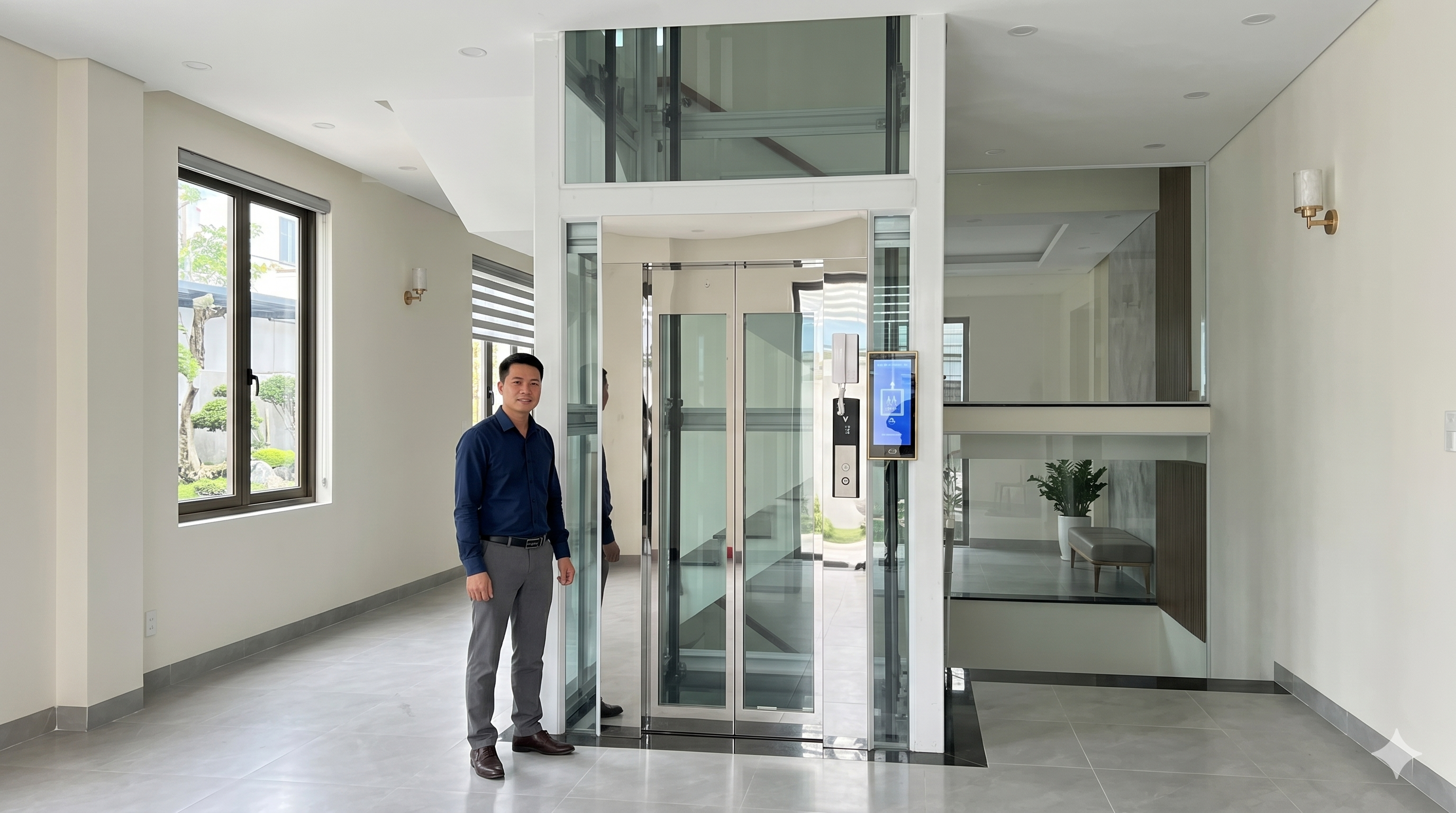
Applications and benefits of 3-door floor elevators
Three-door floor elevators are an advanced technological solution, specifically designed to meet the multi-directional transportation needs in complex architectural structures such as shopping malls, hospitals, luxury hotels, and modern office buildings. Unlike traditional elevators with only one or two doors, three-door floor elevators allow access to the cabin from three different sides, facilitating movement and optimizing user flow.
- Space saving: Three-door floor elevators are often designed as machine-room-less (MRL), minimizing the construction space required for the elevator system. Eliminating the machine room not only saves space but also reduces construction and maintenance costs. This is especially important in buildings with limited space or requiring optimized use of space, such as high-rise urban buildings or crowded city centers.
- Increased transport efficiency: With three floor doors, the elevator allows users to access the cabin from multiple directions, minimizing waiting times and increasing passenger transport capacity during peak hours. This design supports efficient user flow, avoiding congestion at elevator doors. Furthermore, three-floor door elevators can be integrated with intelligent control systems, automatically allocating elevators according to passenger traffic, improving overall operational efficiency.
- High Aesthetic Appeal: The combination of steel frame and tempered glass not only ensures durability but also brings a modern and luxurious look to the building. The transparent glass material enhances natural light, creating a spacious and airy feel for the elevator space. This design is suitable for modern architectural projects, contributing to increased aesthetic value and creating an impressive focal point for the building.
- Absolute safety: The 3-door floor elevator is equipped with advanced safety devices such as door sensors, emergency braking system, anti-jamming control system, and automatic rescue system. These devices are rigorously tested according to international standards, ensuring stable operation and maximum protection for users. In addition, the monitoring and fault warning system helps detect technical problems early, thereby minimizing the risk of accidents and increasing reliability during operation.
- Easy maintenance: The scientifically designed 3-door floor elevator allows technicians quick access to critical components for maintenance and repair. The absence of a machine room minimizes costs associated with mechanical and electronic system maintenance. Furthermore, high-standard components are selected and installed to extend equipment lifespan, reduce maintenance frequency, and improve long-term efficiency.
Practical applications of 3-door floor elevators :
- Shopping malls: With a large and diverse flow of customers, 3-door elevators help to efficiently manage traffic flow, minimize congestion, and enhance the shopping experience.
- Hospitals: Accessibility from multiple directions facilitates the rapid, safe, and convenient transport of patients and medical equipment in emergency situations.
- Hotels and resorts: The luxurious and modern design of the elevators enhances aesthetic value while meeting the diverse transportation needs of guests.
- Office buildings: Help optimize workspace and improve employee transportation efficiency during peak hours.
Key technical factors in the design of a 3-door floor elevator:
- Multi-directional control system: Allows the cabin to move flexibly between doors, ensuring synchronization and safety during operation.
- Safety sensors: Positioned at each door to detect obstructions and prevent accidents caused by door entrapment.
- Materials: High-strength steel frame combined with tempered glass that offers good impact resistance and heat resistance, ensuring durability and safety.
- Automatic rescue system: Automatically brings the cabin to the nearest floor and opens the doors in case of power failure or technical malfunction.
Contact information and services offered
Ngoc Quyet Construction & Trading Co., Ltd. is a leading company in the field of supplying and installing passenger elevators, specializing particularly in 3-door floor elevators – an optimal solution for projects with high demands for convenience and operational safety. With years of experience and a team of professional technicians, Ngoc Quyet is committed to providing comprehensive services that meet all technical and aesthetic standards.
- Consulting on elevator design and selection for your project: Ngoc Quyet's engineering team conducts a detailed survey of the building's current condition, analyzes usage needs, projected passenger traffic, and factors related to space and building structure. Based on this, they provide an optimal 3-door elevator design solution, ensuring a balance between operational efficiency and space saving.
- We supply genuine, brand-new imported elevators with full CO and CQ certifications: Ngoc Quyet collaborates directly with reputable elevator manufacturers worldwide, ensuring high-quality products that meet international standards for safety and performance. Each product comes with a Certificate of Origin (CO) and a Certificate of Quality (CQ), giving customers peace of mind regarding the origin and durability of the equipment.
- Fast, technically sound, and safe elevator installation: The installation process is carried out by a team of certified technicians, strictly adhering to occupational safety regulations and elevator industry technical standards. Construction time is optimized to minimize impact on project timelines, while ensuring the system operates stably and reliably from the first use.
- 24-Month Equipment Warranty, Regular Maintenance, and 24/7 Technical Support: Ngoc Quyet provides comprehensive warranty services for 2 years from the date of acceptance, including free repair of any technical faults. In addition, the company implements a scientifically scheduled regular maintenance program to maintain optimal performance and extend equipment lifespan. The technical support team is available 24/7 to quickly handle emergencies, ensuring continuous and safe elevator operation.
- Operational training and detailed instruction manuals for customers: After installation is complete, Ngoc Quyet organizes in-depth training sessions for the customer's operation and maintenance team, helping them master the operating procedures, safety measures, and basic troubleshooting. Simultaneously, customers are provided with a detailed instruction manual, including technical diagrams, maintenance procedures, and important notes during operation.
Ngoc Quyet's team of experienced technicians not only possesses extensive professional knowledge but also receives regular training to update their skills on the latest elevator technologies. Their professional service system, from consultation and design to product supply, installation, and maintenance, operates according to standardized procedures, ensuring that every project achieves the highest quality.
The 3-door floor elevators supplied by Ngoc Quyet are designed with a multi-directional door opening structure, increasing convenience in movement and minimizing waiting time. The intelligent control system integrates safety features such as anti-jamming sensors, an automatic rescue system in case of power failure, and a smooth operation mode, suitable for various types of buildings from high-end apartments and hotels to modern office buildings.
Ngoc Quyet always prioritizes the selection of elevator materials and components that meet international standards, including:
- Asynchronous motors or permanent magnet (PM) motors help save energy and reduce noise.
- High-quality cables and pulleys ensure durability and safety during operation.
- The modern, user-friendly touchscreen control panel offers multiple languages and display options.
- The energy-efficient LED lighting system creates a luxurious and inviting cabin atmosphere.
In particular, Ngoc Quyet's after-sales service is highly regarded for its dedication and prompt handling of maintenance and repair requests. Customers always receive free technical advice and updates on elevator upgrade solutions that align with new technological trends and the development requirements of their projects.